I–V · The record
Whether a Claim stands is determined.
Whether a Claim stands is determined.
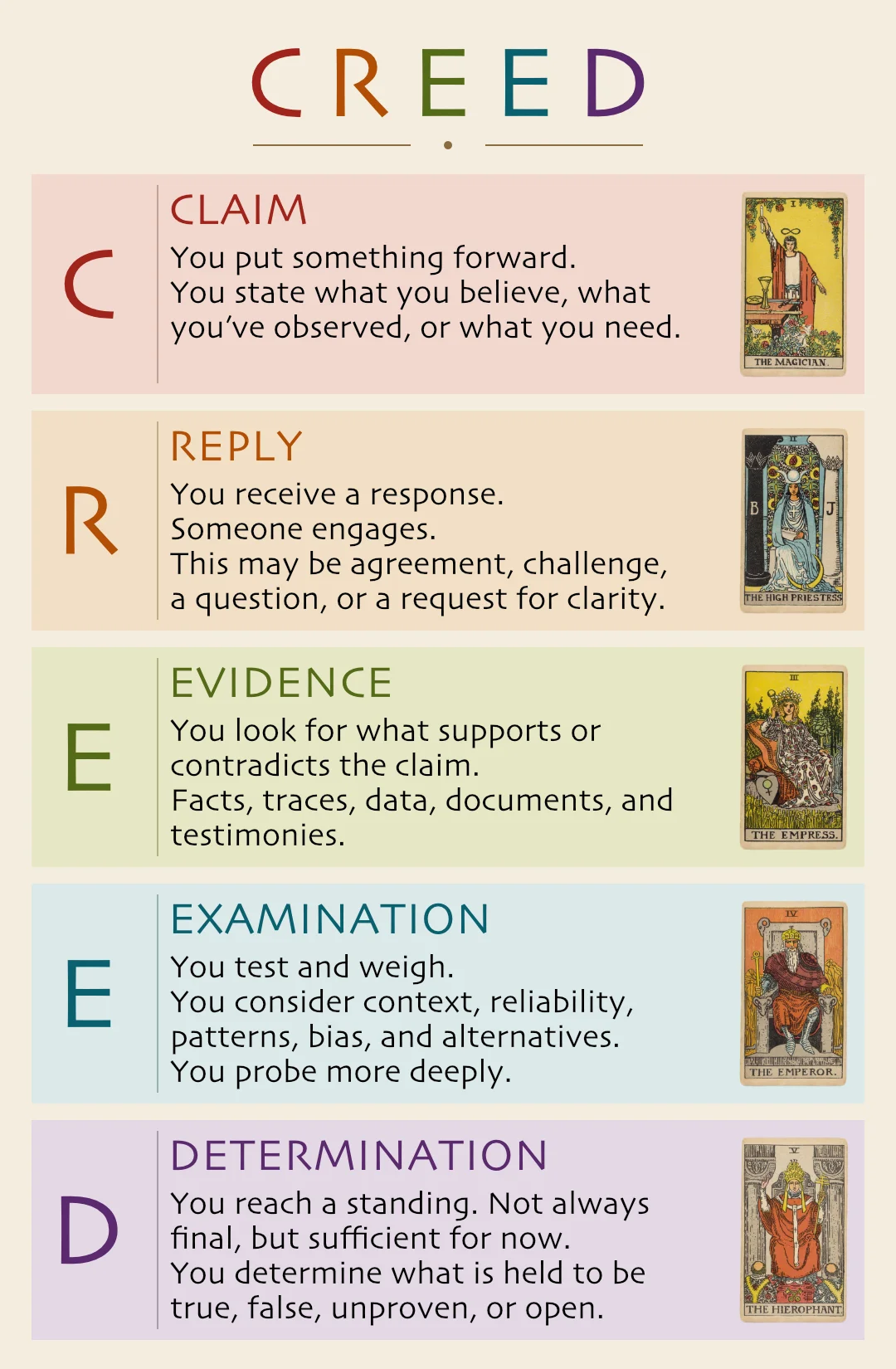
The Creed of Five remains the epistemological heart of Sudaism: the means by which a claim receives a reply, is supported or contradicted by evidence, examined and provisionally determined.
- I · Claim · The Magician
- Something is asserted. You put forward what you believe, what you have observed, or what you need.
- II · Reply · The High Priestess
- The claim encounters another position: agreement, challenge, a question or a request for clarity.
- III · Evidence · The Empress
- Material relevant to the claim is admitted. Facts, traces, documents and testimony may support or contradict it.
- IV · Examination · The Emperor
- Claim, reply and evidence are tested. Context, reliability, patterns, bias and alternatives are weighed.
- V · Determination · The Hierophant
- A provisional Determination is reached: what is held to be true, false, unproven or open. An upheld Claim may be said to stand; this does not make it eternally true.
Everyone has standing.
Standing is the right to make a Claim and have it considered.
Making a Claim does not mean that it stands. A Claim receives Reply, Evidence and Examination before Determination.
At Determination, it may be held true, false, unproven or open. What is upheld may be said to stand.
A rejected Claim does not stand, but remains part of the record.
A Claim may cease to stand. The Claimant does not thereby lose standing.
Not every Claim will stand.
A practising Sudist is known as a Claimant. Claims may be made against individuals, institutions, systems, ideas, objects, other religions, and Sudaism itself.
No person shall be sued merely for not being a Sudist.
Sudaism does not require faith in human systems. It requires that a Claim may be made against them.
This is the machinery of Sudic inquiry. Determination decides whether a Claim is upheld, rejected, unproven or open; it does not complete the journey.